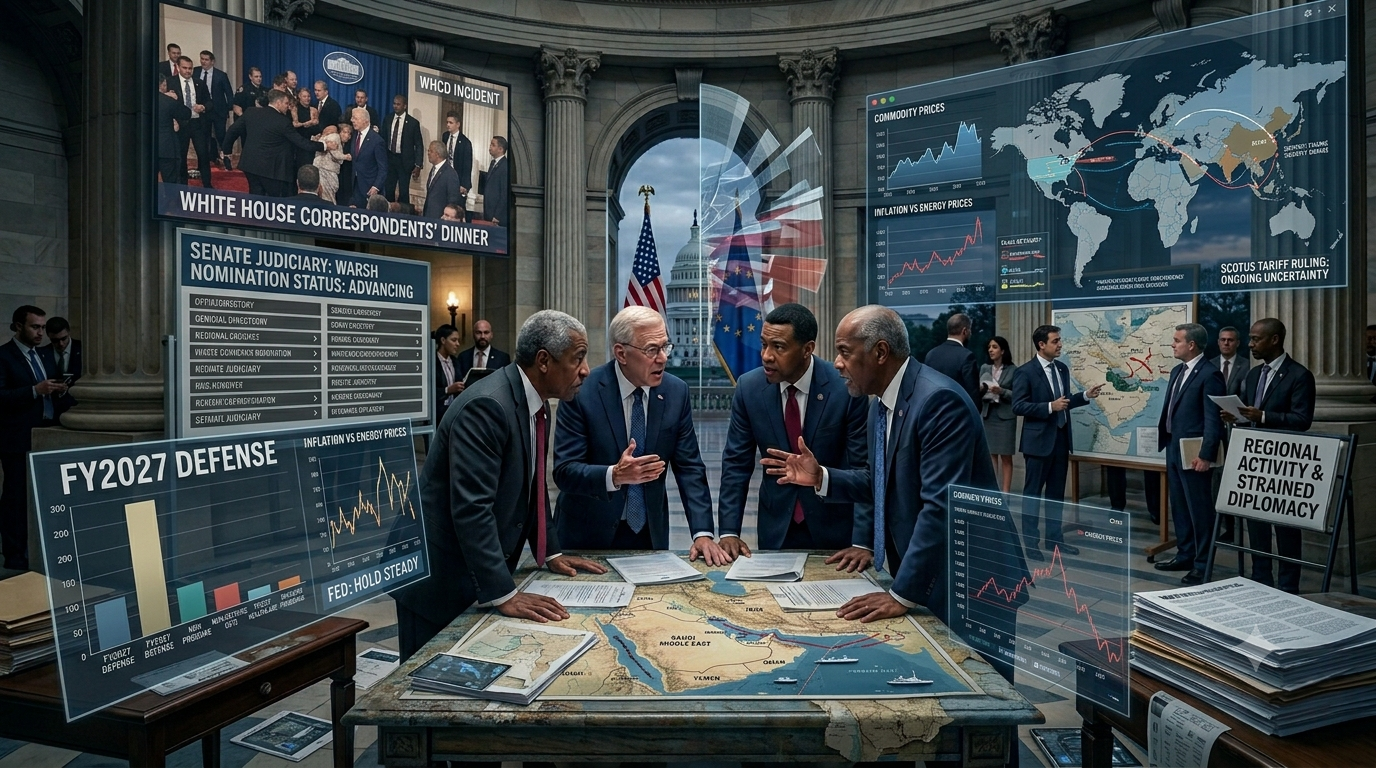
April 2026 The Haizum Washington Dispatch is a monthly intelligence briefing that monitors the most relevant political, economic, regulatory, and strategic developments in the United States. This document focuses on federal policymaking, national security, trade, technology, and macroeconomic dynamics, considering the role of Washington within transatlantic relations, Indo-Pacific strategy, and global geopolitical competition. The report delivers high-level insights by leveraging Haizum’s deep network across the US institutional, policy, and strategic affairs ecosystem. READING TIME: 15 MINUTES This newsletter was prepared for Haizum Strategic Government Affairs. Haizum maintains exclusive rights to circulate this product. All statements of fact and expressions of opinion contained herein are the sole responsibility of the author. This newsletter was produced on Monday, November 24. Developments after that date will be covered in the next issue. SUMMARY The US–Iran conflict remains in a fragile holding pattern, with a temporary ceasefire under strain amid continued regional activity and stalled diplomatic progress. Inflation dynamics and Federal Reserve policy remain closely linked, as energy-driven price pressures and a cautious, data-dependent approach guide the Fed’s decision to hold rates steady. Momentum behind Kevin Warsh’s nomination is advancing in the Senate following the Department of Justice’s decision to drop its inquiry into Chair Jerome Powell. The administration’s FY2027 budget proposal outlines a significant shift toward expanded defense spending alongside reductions in non-defense programs, setting the stage for contentious appropriations negotiations. Congressional Republicans are advancing discussions around a second reconciliation package. One year after the administration’s tariff actions, economic, legal, and sectoral impacts continue to unfold, with ongoing uncertainty following a Supreme Court ruling invalidating key elements of the policy. A shooting incident at the White House Correspondents’ Dinner has heightened concerns around political violence and prompted renewed scrutiny of security protocols. US–Iran Conflict Remains Fragile as Peace Efforts Stall and Alliance Tensions Grow The US–Iran conflict has entered a tenuous holding pattern, with a temporary ceasefire still formally in place but increasingly strained by ongoing military activity and diplomatic uncertainty. The truce, brokered earlier this month to halt hostilities and reopen the Strait of Hormuz, has delivered only partial stability as both sides continue to test its limits. Recent reporting indicates that the Trump administration is dissatisfied with the latest Iranian proposal to move toward a longer-term settlement, raising concerns that negotiations could stall or collapse. According to officials, key disagreements remain over sanctions relief, nuclear constraints, and verification mechanisms. These are issues that have long complicated US–Iran diplomacy. At the same time, the United Nations has renewed calls to fully restore maritime access through Hormuz, underscoring the waterway’s critical importance to global energy flows. On April 7–8, the United States and Iran agreed to a two-week ceasefire mediated by Pakistan, aimed at halting active hostilities and reopening critical maritime routes, particularly the Strait of Hormuz. The waterway, through which a significant share of global energy shipments passes, had been partially closed during the conflict, contributing to supply disruptions and volatility in global oil markets. However, on the ground, the ceasefire has proven uneven. While large-scale direct exchanges between US and Iranian forces have subsided, regional tensions persist. Israeli military operations and activity by Iran-backed groups in Iraq and Lebanon continue to create flashpoints that fall outside or exist on the margins of the current agreement. Analysts from Center for Strategic and International Studies warn that without a broader framework addressing proxy conflicts, the risk of renewed escalation remains high. The conflict is also amplifying divisions within NATO. President Donald Trump has reportedly considered imposing consequences on alliance members perceived as not providing sufficient support, signaling a more transactional approach to alliance management. These tensions complicate coordination at a time when unified Western policy could shape the trajectory of negotiations. Economically, markets remain sensitive to developments. Although oil prices have eased from their peak, volatility persists amid uncertainty over supply routes and enforcement of the ceasefire. Any disruption to Hormuz could quickly reverse recent declines. Diplomatic efforts continue, but momentum appears limited. With core issues unresolved and pressure mounting from both military and political fronts, the coming weeks will be critical in determining whether the ceasefire evolves into a sustainable agreement or gives way to renewed conflict. Fed Holds Steady as March CPI Shows Renewed Inflation Pressures The Federal Reserve has maintained its wait-and-see posture through April, holding the federal funds rate steady at 3.50%–3.75% as policymakers navigate a more complex mix of inflation dynamics, geopolitical risk, and intensifying political scrutiny. While the March Consumer Price Index (CPI) report showed a re-acceleration in headline inflation, driven largely by energy price shocks tied to tensions involving Iran, subsequent data releases and market indicators point to a more uneven and uncertain trajectory rather than a sustained upward surge. Recent communications from Fed leadership, including Chair Jerome Powell, reinforce a cautious and highly data-dependent stance. Policymakers continue to signal that while inflation remains above the 2% target, they are not yet prepared to tighten policy further without clearer evidence of persistent, broad-based price pressures beyond volatile categories such as energy. At the same time, expectations for rate cuts later in 2026 have become increasingly conditional. Several officials have emphasized that any easing will depend not only on inflation moderation but also on signs of softening in labor market conditions and overall economic activity. Momentum behind Kevin Warsh as a successor to Jerome Powell has also accelerated in recent weeks. Key Republican voices, including Thom Tillis, have signaled support following the Department of Justice’s decision to drop its inquiry into Powell, removing a significant political complication that had been intertwined with discussions over Fed leadership. FY2027 Budget Proposal Centers on Defense Expansion and Domestic Spending Reductions In early April, the Trump administration unveiled its FY2027 budget proposal, which outlines a significant reallocation of federal resources, anchored by a substantial increase in defense spending alongside reductions in non-defense programs. The budget requests approximately $1.5 trillion in total defense funding, representing an increase of roughly $445 billion, or more than 40
Dispatch from Rome: April 2026
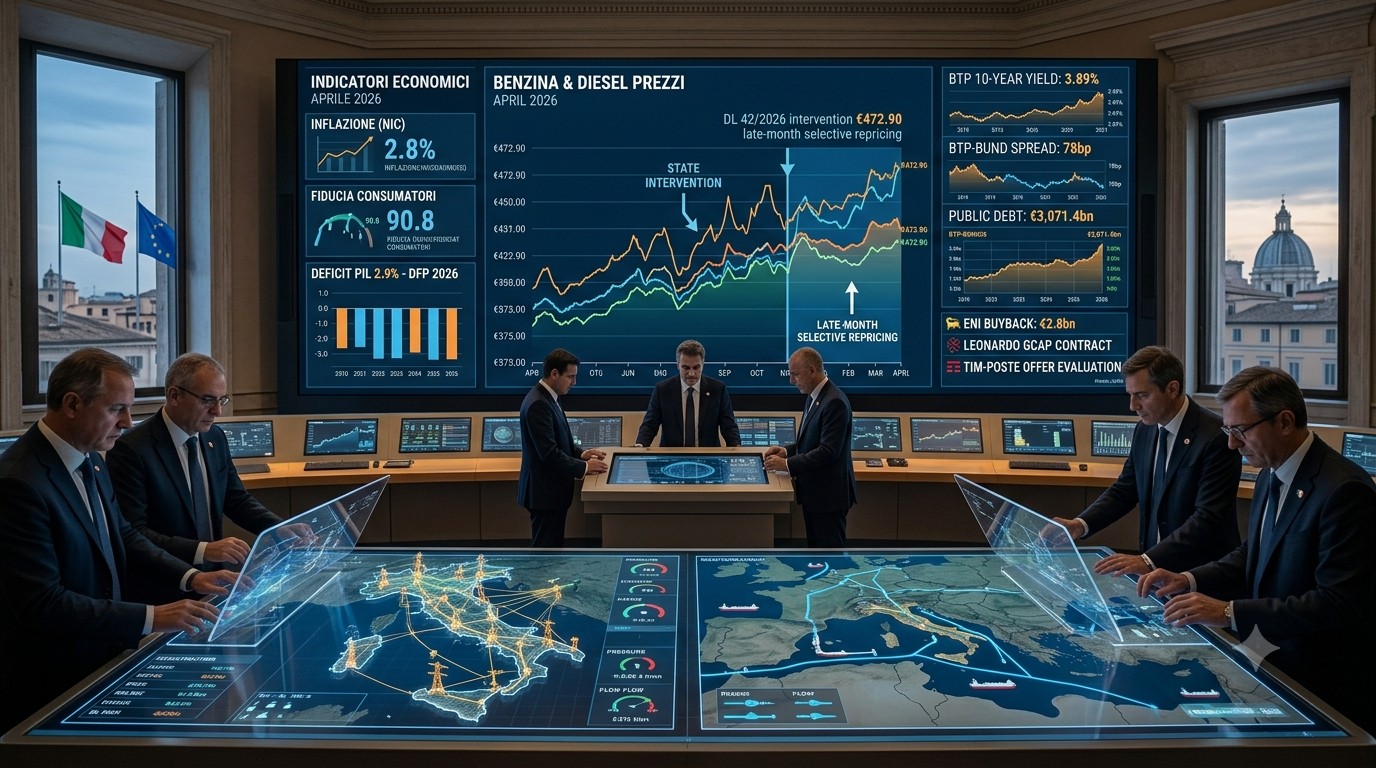
April 2026 The Haizum Italian Insider Report is a monthly news service that monitors the most relevant issues in Italy. This document focuses on political, Economic, and Strategic matters, considering the role of Italy within the European Union, the MENA region, and Transatlantic Relations. The report will deliver clever insights by leveraging Haizum’s deep connections in the national institutional ecosystem. READING TIME: 15 MINUTES Disclaimer: This Report is proprietary and confidential and may not be copied, quoted, referenced, or distributed in any format without the express written approval of Haizum Strategic Government Affairs (“Haizum”). Any violation of the foregoing may result in material harm to Haizum. The views expressed reflect public information or the personal views of the members of Haizum’s Team and in case reflect the view in a general context as expressed in the newsletter and may not represent a view on a specific case. Views expressed are as of the date hereof and Haizum does not undertake to advise you of any changes in the views expressed herein. Opinions or statements regarding financial market trends are based on current market conditions and are subject to change without notice. It should not be assumed that Haizum has made or will make investment recommendations now or in the future irrespective of the views expressed herein. Haizum does make any representation or warranty, express or implied, as to the accuracy or completeness of the information contained in this newsletter and nothing contained herein shall be relied upon as a promise or representation whether as to the past or future performance. Certain factual pieces of information contained herein have been obtained from third-party sources. It has not been independently verified by Haizum and although Haizum believes it to be reliable, Haizum makes no representation as to its accuracy or completeness. This Newsletter is intended solely for informational purposes. It is not investment advice and should not be considered to be a recommendation to buy or sell any type of securities or investments or as an indication that any security is suitable for a particular person. Haizum also may have potential conflicts of interest, including that some of Haizum’s officers, directors, and/or employees may be investors in the securities directly or indirectly. No assurance can be given that any risk management framework described herein will achieve its objective. SUMMARY April 2026 marked the point where Italian policymaking shifted from political positioning to operational crisis management. Three themes dominated the month: repeated executive intervention on energy prices, a more constrained fiscal narrative, and the acceleration of a state-backed industrial-security agenda spanning defense, telecoms, and critical infrastructure. The energy file became the month’s organizing principle. DL 42/2026 cut excise on both gasoline and diesel to €472.90 per 1,000 liters from 8 April to 1 May and set natural-gas motor-fuel excise at zero. By month-end, DL 63/2026 moved from generalized cushioning to selective repricing: gasoline excise was lifted back to €622.90 per 1,000 liters from 2 to 10 May, while diesel remained at €472.90. This shows the government attempting to balance inflation relief, sectoral politics, and fiscal cost in real time. Macroeconomic data validated the sense of pressure rather than collapse. ISTAT’s April showed headline NIC inflation at 2.8% year-on-year, with goods accelerating sharply to 3.2% while services slowed to 2.4%. Consumer confidence fell from 92.6 to 90.8 and business confidence from 97.3 to 95.2. The Documento di Finanza Pubblica DFP 2026, approved 22 April, set the deficit path at 2.9% of GDP in 2026 declining to 2.1% by 2029, with debt peaking at 138.6%. The UPB hearing of 28 April validated the macro framework but trimmed its 2026 GDP estimate to 0.5% against the government’s 0.6%, and flagged interest expenditure reaching 4.1–4.5% of GDP through 2029. Public debt stood at €3,071.4 billion in February. Discretionary room narrowed materially without triggering a crisis. Markets remained open but not complacent. The Minister of Economic and Finance’s 15 April BTP syndication drew over €190 billion in demand, yet Italy’s 10-year yield on 13 April stood at 3.89% with a BTP-Bund spread of 78bp, off the late-March peak but above pre-shock levels. Strategic firms provided some offset: ENI raised CFFO guidance to €13.8 billion and expanded its buyback to €2.8 billion; Leonardo joined the £686 million inaugural GCAP contract; Fincantieri signed a €62 million PPA upgrade and a 51/49 Albanian JV; TIM appointed advisers to evaluate Poste Italiane‘s offer and shareholders approved a 1-for-10 reverse split and €400 million buyback authority. INSTITUTIONS Legislative April’s institutional picture was defined less by ordinary parliamentary initiative than by the conversion of pre-existing emergency texts and the executive’s continued reliance on decree-law instruments. The clearest formal milestones were the Senate’s definitive approval on 8 April of the conversion bill for Decree-Law 21/2026, later published as Law 49/2026 on 18 April, and the publication of Law 54/2026 on 24 April converting Decree-Law 23/2026. Parliament was effectively asked to work in parallel with a new executive emergency cycle: DL 42/2026 on fuel prices on 3 April, DL 62/2026 on wages and labor incentives on 30 April, and DL 63/2026 on renewed fuel-price measures the same day. April therefore confirmed that the legislative center of gravity remained with Palazzo Chigi, with Parliament operating primarily as a conversion and stabilization chamber. In parallel, the National Cybersecurity Agency (ACN) published two new NIS2 Determinations on 13 April with immediate operational impact for entities in scope, reinforcing Italy’s compliance infrastructure ahead of the October 2026 deadline. Government The government’s April behavior was defined by tactical sequencing. The Ministry of Economy and Finance chose not to respond to the energy shock with open-ended relief, but with deliberately temporary and increasingly selective interventions. The first move, DL 42/2026, synchronized lower excise, targeted agricultural relief, and broadened industrial support including a revolving-fund window of up to €800 million for firms hit by higher energy costs or conflict spillovers. The second move, DL 63/2026, made explicit that generalized compensation would not be permanent: gasoline excise was restored to €622.90 from 2–10