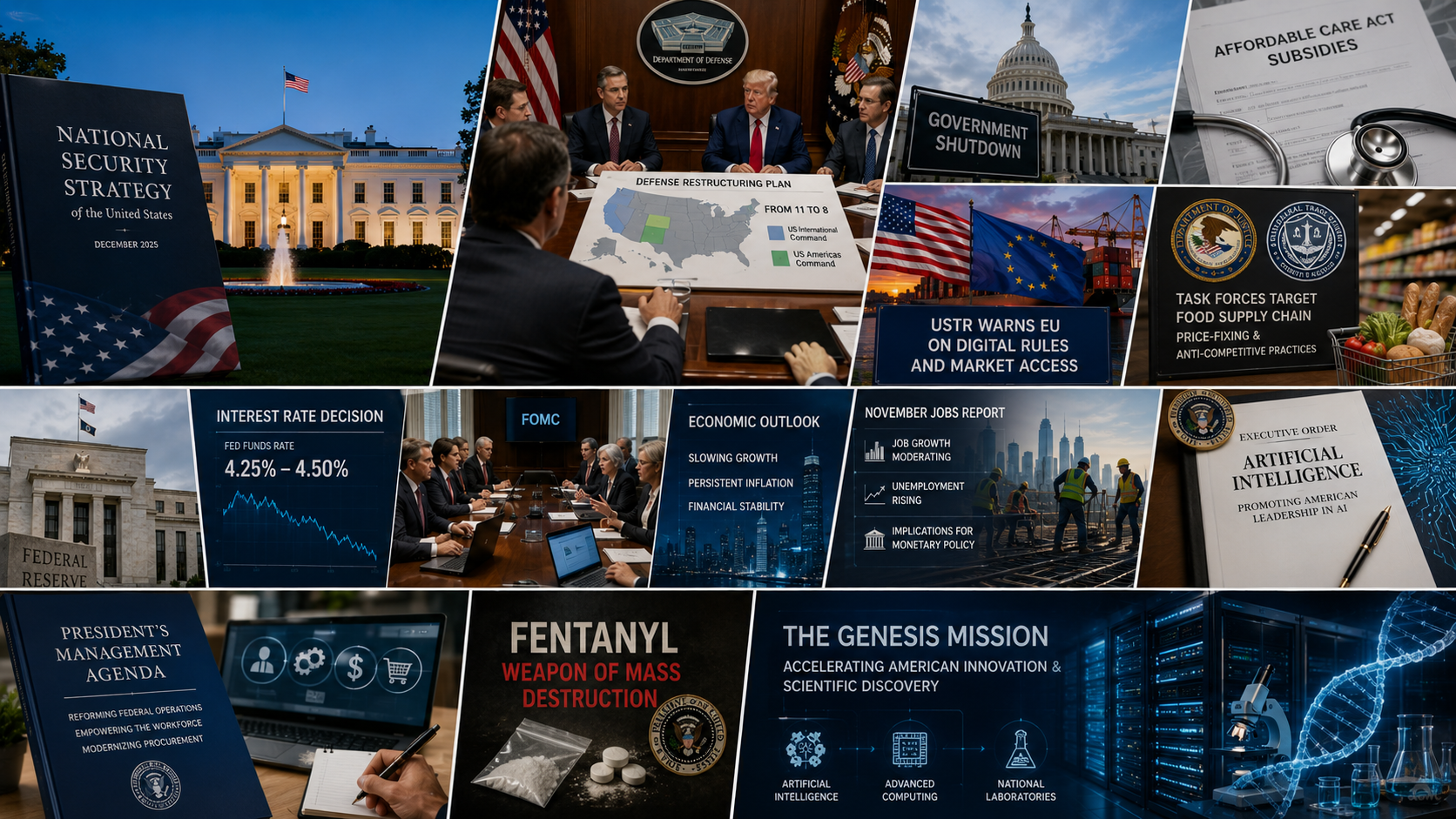
December 2025 The Haizum Washington Dispatch is a monthly intelligence briefing that monitors the most relevant political, economic, regulatory, and strategic developments in the United States. This document focuses on federal policymaking, national security, trade, technology, and macroeconomic dynamics, considering the role of Washington within transatlantic relations, Indo-Pacific strategy, and global geopolitical competition. The report delivers high-level insights by leveraging Haizum’s deep network across the US institutional, policy, and strategic affairs ecosystem. READING TIME: 15 MINUTES This newsletter was prepared for Haizum Strategic Government Affairs. Haizum maintains exclusive rights to circulate this product. All statements of fact and expressions of opinion contained herein are the sole responsibility of the author. This newsletter was produced on Monday, November 24. Developments after that date will be covered in the next issue. SUMMARY The White House’s release of the 2025 National Security Strategy and the Pentagon’s subsequent restructuring plansoutlines a significant shift in US security priorities and military organization. Congressional negotiations over Affordable Care Act subsidies are examined, including their role in the recent government shutdown and the potential for renewed funding tensions in January. Recent warnings from the US Trade Representative toward the European Union highlight escalating transatlantic tensions over digital regulation and market access. New task forces established by the Department of Justice and Federal Trade Commission will focus on alleged price-fixing and anti-competitive practices in the food supply chain. The Federal Reserve’s latest interest-rate decision, internal divisions within the Federal Open Markets Committee (FOMC), and leadership continuity across regional banks are reviewed amid a slowing economic outlook. November’s jobs report provides insight into moderating employment growth, rising unemployment, and implications for monetary policy. A sweeping executive order on artificial intelligence was issued, outlining federal efforts to preempt state-level regulation and triggering a legal and political debate. The administration unveiled a new President’s Management Agenda outlining proposed changes to federal operations, workforce policy, and procurement. President Donald J. Trump designated illicit fentanyl as a weapon of mass destruction. The administration launched “The Genesis Mission,” a federal initiative launched by executive order to integrate artificial intelligence, advanced computing, and national laboratory resources to accelerate US scientific discovery, innovation, and technological leadership. America First — A New Course for US Security Strategy & Transformative US Military Restructure The White House released the 2025 National Security Strategy (NSS) on December 4, outlining a sweeping recalibration of US foreign policy under the banner of “America First.” Its core pillars emphasize protecting the homeland, revitalizing the American economy, maintaining military strength, and advancing US influence abroad, with alliances and partnerships leveraged for American interests rather than as ends in themselves. A central change is the elevation of immigration and border security as national security priorities. The NSS declares that “the era of mass migration must end,” and repurposes military and enforcement resources toward the Western Hemisphere under a renewed Monroe Doctrine, now framed as a “Trump Corollary.” In the Indo-Pacific, the document focuses on competition with China, pledging deterrence in the South China Sea and defense of Taiwan, including a commitment to deny aggression anywhere along the First Island Chain. The NSS also removes democracy promotion from its core agenda. For Europe, the implications are especially stark. The strategy rebukes European allies for what it calls a decline in “civilizational identity,” warns of “civilizational erasure,” and demands that European nations assume full responsibility for their own security and defense, effectively marking a retreat from US leadership in transatlantic cooperation. As described by analysts at the Center for Strategic and International Studies (CSIS), Washington will now favor pragmatic, interest-based relations over idealistic foreign-policy goals, a shift that may leave the US more powerful, but also “lonelier, weaker, more fractured.” Writing in Foreign Affairs, Michael Kimmage notes that the NSS reflects a tension: a bid for renewed American power, but one that rejects older alliances, embraces transactional diplomacy, and abandons commitments to liberal international order. The response abroad has been mixed. Beijing reiterated its willingness to cooperate but warned the US against threatening its core interests, especially over Taiwan. In Moscow, the strategy drew public praise, a senior Russian official lauded its emphasis on sovereignty and described the document as closely aligned with Russia’s own global outlook. Crucially, the NSS’s strategic shift is now being operationalized through sweeping defense restructuring plansemanating from the Pentagon and the Defense Secretary, Pete Hegseth. In the days following the NSS release, senior Pentagon officials, led by Hegseth and Chairman of the Joint Chiefs of Staff Gen. Dan Caine, have drafted proposals to consolidate and overhaul US military command structures to reinforce the NSS’s strategic priorities. Under the emerging plan, the number of geographic combatant commands would be reduced from 11 to eight through the creation of new unified commands, including a US International Command to absorb US Central, European, and Africa Commands, and a proposed US Americas Command (Americom) to unify Northern and Southern Commands. This realignment is intended to streamline command authority, enhance decision-making agility, and shift emphasis toward the Western Hemisphere, consistent with the NSS’s renewed regional priorities. Further changes include significant reductions in the number of four-star generals and admirals, reshaping military leadership to reduce bureaucratic overhead and reallocate resources to frontline readiness. Other restructuring initiatives already underway include the merger of legacy Army commands (such as Army Futures Command and Training and Doctrine Command) into unified formations and the reorganization of sustainment and combat units in accordance with the NSS’s operational priorities. These proposals, which have not yet been submitted in full to Congress, are already generating debate on Capitol Hill. Lawmakers have pressed the Pentagon to provide detailed assessments of cost, force implications, and impacts on alliance commitments before implementation. Taken together, the NSS and the Pentagon’s simultaneous reordering of US defense architecture signal a comprehensive reorientation of American national security policy: away from multilateral engagements and global burden-sharing, and toward a leaner, more centralized military posture aligned with the strategic imperatives articulated in the 2025 NSS. ACA Subsidies Fight Escalates Toward a January
Dispatch from Rome: December 2025
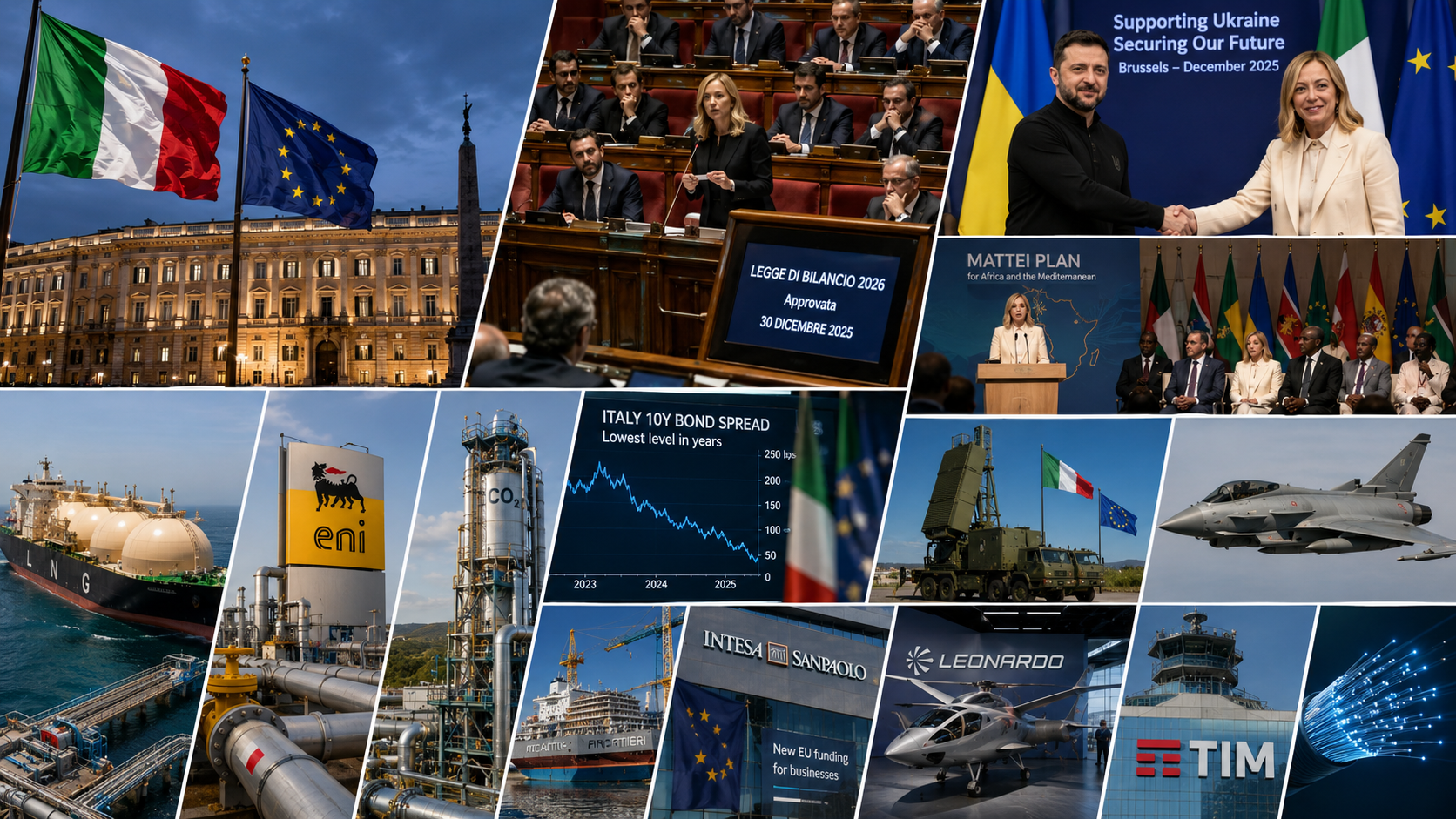
December 2025 The Haizum Italian Insider Report is a monthly news service that monitors the most relevant issues in Italy. This document focuses on political, Economic, and Strategic matters, considering the role of Italy within the European Union, the MENA region, and Transatlantic Relations. The report will deliver clever insights by leveraging Haizum’s deep connections in the national institutional ecosystem. READING TIME: 15 MINUTES Disclaimer: This Report is proprietary and confidential and may not be copied, quoted, referenced, or distributed in any format without the express written approval of Haizum Strategic Government Affairs (“Haizum”). Any violation of the foregoing may result in material harm to Haizum. The views expressed reflect public information or the personal views of the members of Haizum’s Team and in case reflect the view in a general context as expressed in the newsletter and may not represent a view on a specific case. Views expressed are as of the date hereof and Haizum does not undertake to advise you of any changes in the views expressed herein. Opinions or statements regarding financial market trends are based on current market conditions and are subject to change without notice. It should not be assumed that Haizum has made or will make investment recommendations now or in the future irrespective of the views expressed herein. Haizum does make any representation or warranty, express or implied, as to the accuracy or completeness of the information contained in this newsletter and nothing contained herein shall be relied upon as a promise or representation whether as to the past or future performance. Certain factual pieces of information contained herein have been obtained from third-party sources. It has not been independently verified by Haizum and although Haizum believes it to be reliable, Haizum makes no representation as to its accuracy or completeness. This Newsletter is intended solely for informational purposes. It is not investment advice and should not be considered to be a recommendation to buy or sell any type of securities or investments or as an indication that any security is suitable for a particular person. Haizum also may have potential conflicts of interest, including that some of Haizum’s officers, directors, and/or employees may be investors in the securities directly or indirectly. No assurance can be given that any risk management framework described herein will achieve its objective. SUMMARY December 2025 saw Italy wrapping up a turbulent year with high-stakes budget maneuvers, strategic industrial shifts, and assertive diplomatic engagements. Prime Minister Giorgia Meloni’s government narrowly steered a €22 billion budget law through Parliament in late December, with the decisive vote on December 30, 2025, touting “impossible” feats in tax cuts and welfare funding, even as coalition rifts flared over last-minute allocations disputed within the majority. In foreign affairs, Rome balanced steadfast support for Ukraine with cautious limits: Meloni joined EU leaders in backing new Ukraine aid but reiterated that Italy would not deploy troops to Ukraine. Meanwhile, Italy pressed its Mattei Plan vision of energy and development partnerships in the Mediterranean, aligning European support for North Africa amid ongoing migration and security challenges. On the economic front, Italy notched a win as the EU approved a €12.8 billion Recovery Plan disbursement after Rome met 32 reform milestones. This bolstered a slowing economy, which closed 2025 with modest ~0.4% growth (among the weakest in the EU), but easing inflation and lower bond spreads boosted fiscal breathing. Energy security markedly improved: by year-end Italy had reduced Russian gas imports to marginal levels replacing them with supplies from Algeria, Egypt and beyond. National oil major ENI doubled down on this diversification, inking new long-term LNG contracts in Asia and the Middle East, and bringing in a global infrastructure investor as a minority partner in its carbon capture and storage business. In parallel, defense modernization accelerated, Italy tapped EU “SAFE” funds for military procurement and awarded Leonardo new radar contracts, while domestic security strategy gained urgency with a critical-infrastructure resilience agenda moving forward. Across Italy’s strategic industries, December brought transformation: Fincantieri expanded into subsea telecom cables, Intesa Sanpaolo unlocked fresh EU funding for businesses, Leonardo showcased cutting-edge aviation technology, and Telecom Italia edged closer to a historic network spin-off. In sum, Italy ended 2025 on a proactive note, building on its G7-era momentum to fortify economic and security foundations at home and amplify its voice in Europe’s strategic debates. INSTITUTIONS Legislative Italy’s controversial repeal of the “abuse of office” crime for public officials, enacted in 2024, met an EU response in December. European institutions agreed on an anti-corruption directive setting minimum standards, which, once adopted and transposed, would limit member states’ ability to fall below a common baseline. Meloni’s government had resisted making abuse of office a mandatory crime, fearing constraints on local administrators, but ultimately converged on the trilogue compromise. The new directive would require Italy, after transposition, to ensure its criminal-law framework meets the directive’s minimum standards Anti-graft advocates described it as a step forward toward common standards, ensuring no EU country, not even Italy, can drop below the agreed baseline in fighting corruption. Rome is expected to prepare implementing legislation to avoid infringement proceedings. Amid this reform push, Italian institutions saw other notable developments. After months of scrutiny over a cybersecurity breach at defense firm Leonardo, the situation triggered a national security alarm and highlighted the need for stronger internal oversight and cyber resilience. Separately, Parliament’s committees advanced key appointments for governance bodies including the state railways and the data protection authority. These moves, paired with December’s anti-corruption measures, underscore Italy’s effort to shore up institutional credibility heading into 2026. Government The Meloni government navigated a fraught 2026 budget process that climaxed in late December. On December 23 the Senate delivered the key confidence vote on the €22 billion budget bill, enabling tax cuts for middle- income families and an increase in welfare support despite tight fiscal margins. Economy Minister Giorgetti lauded the package, claiming the government “did things that seemed impossible” and projecting a 2.8% of GDP deficit in 2026, according to