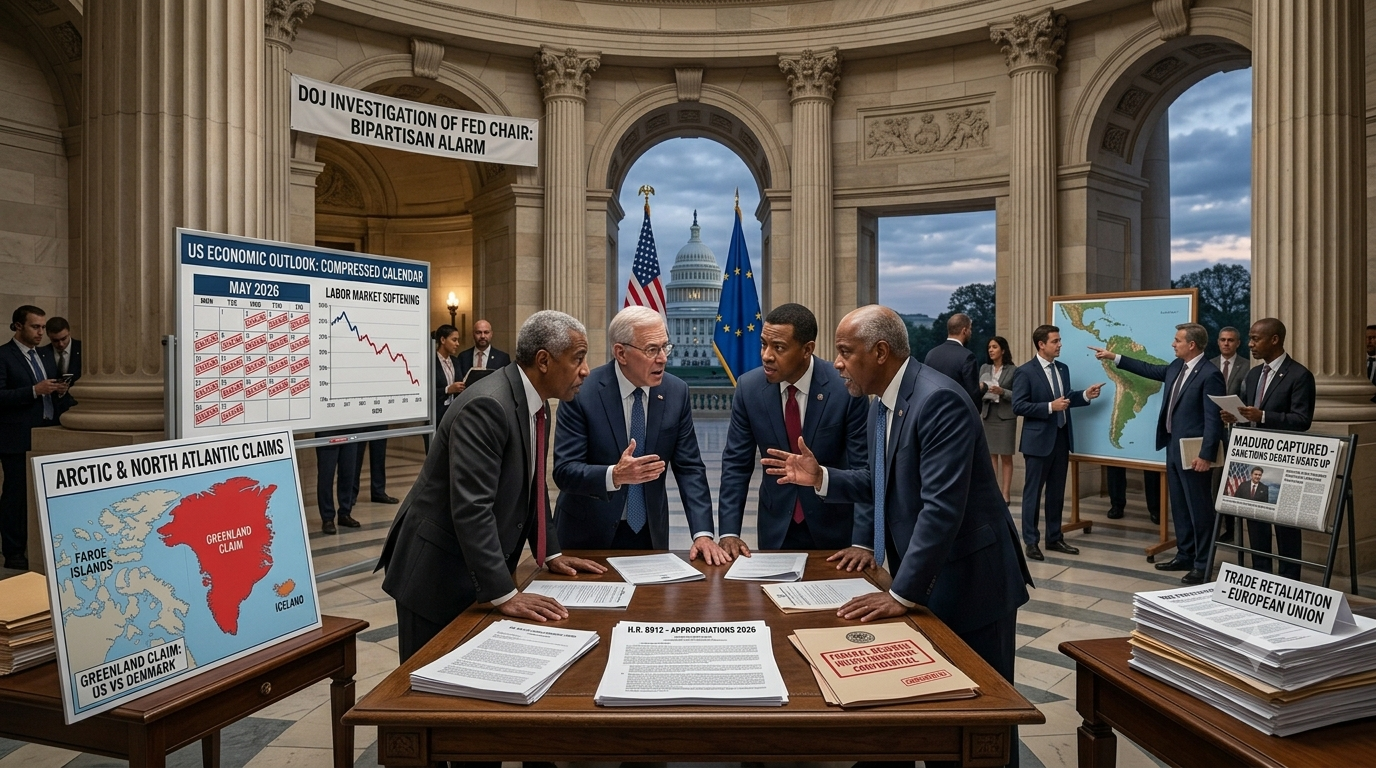
January 2026 The Haizum Washington Dispatch is a monthly intelligence briefing that monitors the most relevant political, economic, regulatory, and strategic developments in the United States. This document focuses on federal policymaking, national security, trade, technology, and macroeconomic dynamics, considering the role of Washington within transatlantic relations, Indo-Pacific strategy, and global geopolitical competition. The report delivers high-level insights by leveraging Haizum’s deep network across the US institutional, policy, and strategic affairs ecosystem. READING TIME: 15 MINUTES This newsletter was prepared for Haizum Strategic Government Affairs. Haizum maintains exclusive rights to circulate this product. All statements of fact and expressions of opinion contained herein are the sole responsibility of the author. This newsletter was produced on Monday, November 24. Developments after that date will be covered in the next issue. SUMMARY Congress returned to Washington DC facing a compressed 2026 legislative calendar, with expiring government funding, unresolved appropriations, and major reauthorizations colliding with the constraints of an election year. Lawmakers are simultaneously grappling with easing inflation, solid recent GDP growth, and signs of softening labor-market momentum that complicate the economic outlook and the Federal Reserve’s path forward. Institutional tensions have intensified following the Justice Department’s unprecedented criminal investigation of Federal Reserve Chair Jerome Powell, raising bipartisan alarm over central bank independence and political pressure on monetary policy. Abroad, relations with Europe have entered a volatile phase as the Trump administration’s push to assert control over Greenland sparks trade retaliation threats, alliance strain, and renewed debate over sovereignty and NATO cohesion. The administration has also dramatically escalated US policy toward Venezuela with the military capture of President Nicolás Maduro, injecting urgency into congressional debates over war powers, sanctions, and executive authority. At the same time, a sweeping White House directive to withdraw the United States from dozens of international organizations and treaties signals an accelerated retreat from multilateral engagement, raising legal, diplomatic, and strategic questions about America’s role in the global order. Congressional Agenda: Key Policy Priorities and Deadlines for the Year Ahead As the 119th Congress reconvenes for the first session of 2026, lawmakers confront a tightly packed legislative calendar shaped by looming deadlines, unresolved priorities from 2025, and an election-year clock that will compress the time available for floor action. With extended recesses planned for summer and fall, the House is expected to be in session for fewer than 30 weeks and the Senate just over 30, intensifying pressure to sequence votes around funding deadlines and authorizations. The most immediate priority for Capitol Hill leadership remains averting another government shutdown. A continuing resolution that has been funding much of the government is set to expire on January 30, creating a narrow window for Congress to complete work on the remaining appropriations bills for fiscal year 2026. Both chambers have taken steps toward full-year funding, including a three-bill appropriations package covering Defense, Homeland Security, Labor-HHS-Education, and Transportation-HUD, but negotiations on several politically sensitive bills continue. Failure to finish this work by the CR deadline could trigger renewed funding gaps. Health care remains central to the early agenda, particularly the debate over the expiration of enhanced Affordable Care Act (ACA) premium subsidies. These expanded subsidies, enacted during the COVID-19 pandemic and extended through 2025, ended on January 1, 2026, causing average premiums for many enrollees to more than double and prompting a significant drop in enrollment during this year’s open enrollment period. In early January, the House passed a three-year extension of the enhanced subsidies, winning bipartisan support as 17 Republicans joined Democrats in backing the measure. However, a similar proposal failed in the Senate late last year, and lawmakers are now negotiating a compromise deal that could include new eligibility limits and potentially extend the ACA enrollment period into March. Other major reauthorizations lie ahead this year, including surface transportation programs and surveillance authorities under FISA, all of which are likely to spark extensive negotiations over funding levels and policy riders. Procedural innovations such as discharge petitions on issues like congressional stock trading prohibitions and Russia sanctions could also shape legislative dynamics, reflecting bipartisan appetite to force floor votes outside traditional leadership control. Trade and industrial policy remain in focus as well, with ongoing debates over congressional oversight of tariff authority and proposals like the Trade Review Act potentially moving forward later in the year. Finally, the White House and key Republicans have signaled interest in further budget reconciliation efforts in 2026. While President Trump has at times downplayed the need for new reconciliation measures following the passage of the One Big Beautiful Bill Act, senior GOP officials see reconciliation as a tool to advance priority policies in health care, housing, and crime prevention without requiring 60 votes in the Senate. Foreign policy issues, including ongoing scrutiny of the administration’s actions on Venezuela and war powers matters, as well as tensions over Greenland (see subsequent sections), are also expected to emerge in committee hearings and floor debate, illustrating how international developments intersect with domestic legislative priorities. Overall, funding the government, addressing health care affordability, managing major authorizations, and advancing procedural reforms will dominate the congressional calendar in a year constrained by session limits and the upcoming election cycle. US Economy in Early 2026 – Inflation Eases Amid Mixed Growth Signals As 2026 begins, the US economy presents a nuanced picture: inflation pressures are cooling, growth remains solid, but the labor market shows signs of weakening momentum. Recent labor data indicate a modest 50,000 jobs added in December 2025, with the unemployment rate falling to 4.4 percent from November’s revised 4.5 percent. The employment gains were strongest in sectors such as health care and hospitality, while retail and other areas lagged. Overall, the labor market’s “low hire, low fire” pattern, characterized by subdued hiring and minimal layoffs, continues to temper confidence about future wage growth and consumer demand. On the inflation front, delayed government data shows that consumer prices rose 2.7 percent year-over-year through November, with core inflation (excluding food and energy) also near that level. These
Haizum’s Outlook 2026
January 2026 The global landscape entering 2026 is increasingly shaped by geopolitical fragmentation, assertive power politics, and intensifying technological competition. This report examines the key events and structural trends likely to influence international decision-making throughout the year, from escalating crises in Venezuela and Iran to strategic tensions over Greenland and shifting dynamics highlighted at the World Economic Forum in Davos. Looking ahead, the analysis explores the trajectory of major conflicts, including Ukraine and the Middle East, growing pressure from China on Taiwan, and the accelerating geopolitical race around artificial intelligence. While the global economy shows signs of resilience, underlying vulnerabilities linked to trade fragmentation, supply chains, and political polarization continue to shape the outlook for 2026. Read our overview For an in-depth analysis download our full report here!